
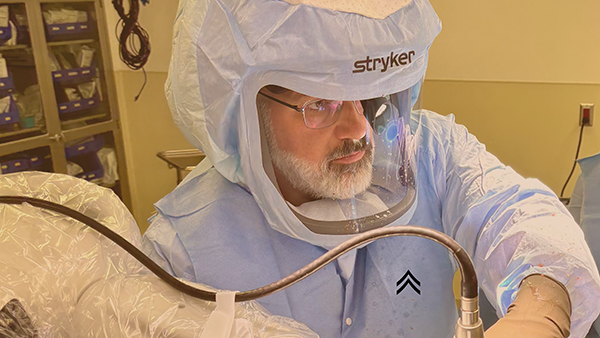
Robotic technology has changed the conversation around joint replacement, and for good reason. But a robotic arm doesn't perform surgery on its own, it's a tool guided entirely by the surgeon holding it. With more than 8,500 joint replacement surgeries and thousands of robotic-assisted procedures behind him, Dr. Paul Jacob's experience is what actually determines how that technology translates into results. Understanding why experience still matters, even in an era of surgical robotics, helps patients make a more informed choice.
What Robotic Technology Actually Does
Mako Robotic-Arm-Assisted surgery has earned its reputation for a reason. Using pre-operative imaging, the system creates a personalized 3D model of a patient's hip or knee, allowing the surgeon to plan implant size and positioning with a level of precision that freehand techniques can't match. During surgery, the robotic arm helps execute that plan within pre-defined boundaries, reducing the room for error in bone preparation and implant alignment.
That precision matters. Poorly aligned implants are one of the leading causes of premature wear, instability, and revision surgery down the road. But precision in planning and execution is only part of the equation.
The Robot Doesn't Make the Judgment Calls
What a robotic system cannot do is decide how to handle a patient's unique anatomy in real time, adjust for scar tissue from a prior injury, manage unexpected bone quality, or recognize when a textbook approach needs to be modified for a specific patient. Those judgment calls come entirely from the surgeon's training and repetition.
This is where the distinction between a surgeon who has performed a handful of robotic cases and one who has performed thousands becomes significant. Experience builds pattern recognition, the ability to anticipate complications before they happen and adapt mid-procedure rather than reacting after the fact. A surgeon who has completed thousands of hip and knee replacements has effectively seen the range of anatomical variation and surgical challenges that a newer surgeon simply hasn't yet encountered.
Why Case Volume Correlates With Better Outcomes
Orthopedic research has consistently pointed to a relationship between surgeon and hospital case volume and patient outcomes, including lower complication rates and shorter recovery times. This holds true whether a procedure is performed with robotic assistance or not.1 The robot standardizes certain mechanical aspects of the surgery, but the surgeon's cumulative experience still shapes decisions about implant selection, soft tissue balancing, and how aggressively to pursue outpatient recovery protocols.
For patients considering total hip replacement, total knee replacement, or partial knee replacement, this means the question worth asking isn't only "does my surgeon use a robot," but "how many of these procedures, robotic and otherwise, has my surgeon actually performed."
Where Muscle-Sparing Technique Fits In
Experience also shows up in technique choices that go beyond the robotic arm itself. Muscle-sparing approaches, such as the subvastus technique used in some total knee replacements, are designed to preserve surrounding muscle tissue rather than cutting through it, which can support a faster, less painful recovery. Choosing when a muscle-sparing approach is appropriate, and executing it well, again depends on surgical judgment refined over thousands of cases rather than the robotic system itself.
How Experience Supports Faster, Safer Recovery
Surgeons with extensive case experience are often better positioned to offer outpatient and rapid recovery joint replacement protocols, allowing appropriate candidates to go home the same day as their procedure. This isn't a decision made lightly. It requires confidence, built through repetition, in anticipating how a specific patient will respond to surgery and recover afterward. Robotic assistance can support these protocols, but the surgeon's experience is what makes same-day discharge a realistic and safe option for the right patients.
Frequently Asked Questions
Is robotic knee or hip replacement better than traditional surgery?
Robotic-assisted surgery offers greater precision in implant positioning and alignment, which can contribute to better outcomes. However, the surgeon's skill and experience remain the primary factor in how well that precision translates into a successful result.
Does more surgical experience actually lead to better joint replacement outcomes?
Research has generally shown that higher surgeon and hospital case volumes correlate with lower complication rates, better implant longevity, and shorter recovery times, regardless of whether a procedure is robotic-assisted. 2 3
What does a robotic arm actually do during joint replacement surgery?
The robotic arm helps execute a personalized surgical plan created from pre-operative imaging, assisting with precise bone preparation and implant placement within boundaries set and controlled by the surgeon.
How many robotic-assisted joint replacements has Dr. Jacob performed?
Dr. Jacob has performed more than 4,000 robotic-assisted hip and knee replacement surgeries, part of a broader surgical career spanning more than 8,500 joint replacement procedures.
Can I still be a candidate for outpatient joint replacement if my case is complex?
Candidacy for outpatient and rapid recovery joint replacement depends on individual health factors and the complexity of the case. An experienced surgeon is often better equipped to evaluate whether a same-day discharge protocol is appropriate for a given patient.
Choosing a Surgeon, Not Just a Technology
Robotic-assisted surgery has genuinely improved precision in joint replacement, but the technology is only as good as the hands guiding it. When evaluating options for hip or knee replacement, experience and case volume deserve just as much consideration as the equipment used in the operating room. A consultation is the best way to understand how that experience applies to your specific joint health needs.
Reference Links:
AUTHOR: Dr. Paul B. Jacob, DO, MSPT, FAAOS - Master Surgeon
Dr. Paul B. Jacob, DO, MSPT, FAAOS, is a certified Master Surgeon in joint replacement and robotic joint replacement of the hip and knee at the Oklahoma Joint Reconstruction Institute. Dr. Jacob is recognized as one of the Top 3 Orthopedic Surgeons in Oklahoma, who has performed over 7000 robotic joint replacement procedures. Dr. Jacob is active in numerous research studies on joint replacement technology and robotic outcomes. He provides advanced, minimally invasive solutions designed to restore mobility, reduce pain, and support faster recovery.
Credentials & Recognition
Dr. Jacob earned his Doctor of Osteopathic Medicine from Ohio University Heritage College of Osteopathic Medicine and also holds a Master of Science in Physical Therapy. He completed orthopedic residency training followed by fellowship training in adult reconstruction at Cleveland Clinic. He is board-certified by the American Osteopathic Board of Orthopedic Surgeons, a Fellow of the American Academy of Orthopaedic Surgeons, and has achieved Master Surgeon accreditation in both Joint Replacement and Robotic Joint Replacement from the Surgical Review Corporation.
Awards & Recognition
Dr. Jacob has been named one of the Top 3 Orthopedic Surgeons in Oklahoma City by ThreeBestRated®, selected through a rigorous 50-point inspection covering reputation, patient satisfaction, and clinical excellence. He was also recognized by Becker's Healthcare as one of the "10 Orthopedic Surgeons to Know." In 2022, Dr. Jacob became the first orthopedic surgeon in Oklahoma to earn Surgical Review Corporation accreditation as a Master Surgeon in both joint replacement and robotic joint replacement.
Clinical Expertise
Dr. Jacob specializes in primary and revision hip and knee replacement, robotic-assisted joint surgery, minimally invasive techniques, and rapid-recovery protocols aimed at improving long-term joint function and patient outcomes.
Medical Disclaimer: This information is for educational purposes only and does not constitute medical advice. For diagnosis and treatment recommendations, please consult with Dr. Jacob at the Oklahoma Joint Reconstruction Institute.
Content authored by Dr. Paul B. Jacob and verified against official sources.